
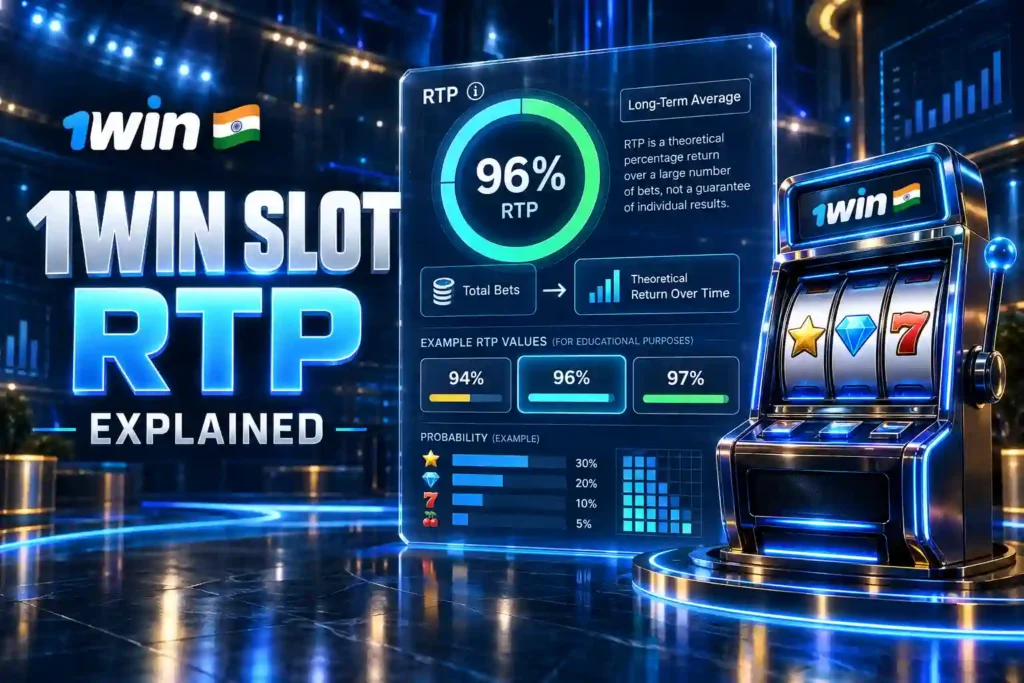
When exploring online slots, one of the figures players may come across is RTP, or Return to Player. It is commonly shown as a percentage and is designed to describe the theoretical amount a slot may return to players over a very large number of spins.
Understanding RTP can help players read slot information more accurately. However, it is important to remember that RTP is a long-term statistical figure, not a guarantee of what will happen during an individual playing session.
This guide explains what RTP means, how it works, and what to consider when comparing slot games on 1Win.
What Does RTP Mean in Slots?
RTP stands for Return to Player. It is a theoretical percentage representing the amount of money a slot is designed to return to players over a large number of plays.
For example, a slot with a theoretical RTP of 96% is designed to return approximately ₹96 for every ₹100 wagered over a very large sample of spins.
The remaining percentage represents the theoretical house edge.
RTP Example
| Theoretical RTP | Theoretical House Edge |
|---|---|
| 95% | 5% |
| 96% | 4% |
| 97% | 3% |
| 98% | 2% |
These figures describe mathematical expectations over a large number of plays. They do not mean that a player will receive the stated percentage back during a particular session.
How Does Slot RTP Work?
RTP is calculated using the mathematical design of a slot.
Game developers determine factors such as:
- Winning combinations
- Payout values
- Reel layouts
- Symbol frequencies
- Bonus features
- Free spins
- Special game mechanics
These elements contribute to the game’s theoretical return percentage.
If a slot has a 96% RTP, that figure comes from the game’s underlying mathematical model rather than from the results of a single player’s session.
Check Out: 1Win Game Providers – Casino Studios & Gaming Partners
Does a Higher RTP Mean You Will Win More?
Not necessarily.
A higher theoretical RTP can indicate a lower mathematical house edge over a very large number of plays, but it does not predict the outcome of your next spin.
Slots use random outcomes, so a player could experience several wins, several losses, or a combination of both regardless of the published RTP.
For this reason, RTP should be viewed as one piece of information about a slot, rather than a prediction tool.
RTP vs House Edge
RTP and house edge describe opposite sides of the same mathematical relationship.
For example:
RTP = 96%
means the theoretical house edge is:
100% − 96% = 4%
RTP describes the theoretical return to players, while house edge describes the theoretical percentage retained by the casino over a very large number of plays.
Neither figure tells you what will happen in a short session.
RTP Does Not Apply to Every Spin
One common misunderstanding is that RTP is applied to every individual spin.
It isn’t.
Suppose a game has a theoretical RTP of 96%. This does not mean every ₹100 wager will return ₹96, or that every group of 100 spins will produce exactly the advertised percentage.
Individual results can vary considerably.
RTP becomes meaningful when considering a very large number of game outcomes, where actual results may move closer to the mathematical expectation.
Read: Free Spins at 1Win – How to Activate and Wager Them
What Is Slot Volatility?
RTP is not the only characteristic worth understanding.
Volatility, sometimes called variance, describes how a slot’s wins are generally distributed.
A simplified way of looking at volatility is:
- Lower volatility: wins may occur more frequently but can be smaller.
- Higher volatility: wins may occur less frequently but can be larger.
- Medium volatility: characteristics generally fall between the two.
Two games can have similar RTP percentages while producing very different playing experiences because their volatility can differ.
RTP and Volatility Are Different
It is useful not to confuse these two concepts.
RTP tells you about the game’s theoretical long-term return.
Volatility provides information about how frequently and how substantially wins may occur.
For example, two slots could both advertise a similar RTP while one has lower volatility and another has higher volatility.
Looking at both figures can provide a more complete understanding of a game’s mathematical characteristics.
Can RTP Predict a Winning Slot?
RTP should not be used to predict whether a particular spin will win.
Each spin is an individual game outcome, and previous results do not guarantee future results.
For example, if a slot has experienced several losing spins, that does not mean a winning spin is now “due.” Similarly, a recent win does not mean another win is less likely simply because the previous spin paid out.
This is why RTP should be treated as statistical information rather than a prediction of short-term results.
Browse Slot Games and Learn How Each Game Works
Where Can You Find RTP Information?
Depending on the game and platform, RTP information may be available through:
- The game’s information or help section
- The slot’s rules
- The game provider’s documentation
- Paytable or game settings
- 1Win platform game information
Before playing a particular slot through 1Win, check the information provided for that specific game rather than assuming every slot has the same RTP.
Why Do Different Slots Have Different RTPs?
There is no single RTP percentage used across all slot games.
Game developers can create different mathematical models for different titles. Features such as payout structures, bonus rounds, jackpots and symbol frequencies can influence the game’s theoretical return.
Some games may therefore have higher or lower RTP figures than others.
The published RTP should always be considered specific to the individual game.
RTP and Bonus Features
Bonus rounds, free spins and other features can form part of a slot’s overall mathematical model.
For example, a game’s theoretical RTP may account for payouts generated during:
- Base-game spins
- Free-spin rounds
- Bonus games
- Special symbol combinations
- Other built-in features
This means you should consider the complete game design rather than looking at a single feature in isolation.
Want to make the most of 1Win bonuses and promotions? Check the latest offers, eligibility details, and wagering terms before you claim.
What Should You Check Besides RTP?
When researching a slot, RTP can be considered alongside other basic game information, including:
- Volatility
- Maximum potential payout
- Paytable
- Bonus features
- Game rules
- Minimum and maximum stakes
- Provider information
- Any applicable terms and conditions
Understanding these characteristics can help you make more informed decisions about which games you want to explore.
Want to learn how to win at 1Win with a more informed approach? Explore practical strategies, game tips, and key factors to consider before you play.
Final Thoughts
RTP, or Return to Player, is a theoretical percentage used to describe the long-term mathematical return of a slot game.
It can be useful when comparing game information, but it should not be interpreted as a guarantee of winnings or a prediction for individual spins.
When reviewing slots on 1Win, consider RTP together with volatility, game rules, features and the available game information. Most importantly, treat RTP as a statistical measure and approach slot play as entertainment rather than a guaranteed way to make money.